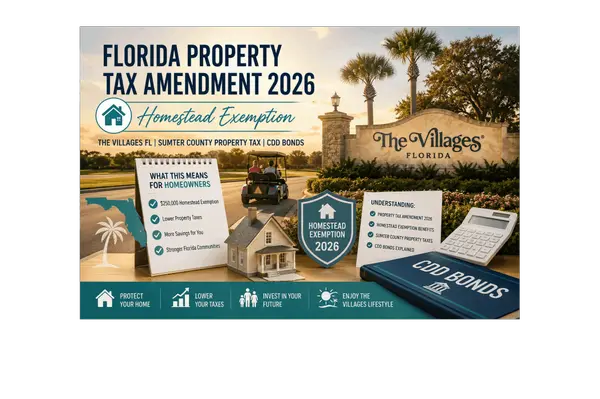
Florida's Property Tax Elimination: What It Actually Means If You're Buying or Selling in The Villages
What does Florida's 2026 property tax amendment mean for homeowners in The Villages?
On June 2, 2026, Florida lawmakers approved a constitutional amendment — now headed to the November ballot — that would expand the homestead exemption to $250,000 for non-school property taxes. If voters approve it, homeowners in The Villages with homesteaded properties could see significant annual tax savings starting in 2027. School district taxes are not eliminated, and CDD fees and amenity fees are unaffected. The amendment requires 60% voter approval to pass.
By Gina Battaglia, REALTOR® | June 2, 2026
Something big happened in Tallahassee today — and if you own a home in The Villages, or you're planning to buy one, you need to understand exactly what it means for your wallet.
Florida lawmakers voted to send a sweeping property tax relief amendment to the November 2026 ballot. The proposal, backed by Governor Ron DeSantis and approved 30–9 in the Senate and 75–26 in the House, would dramatically expand Florida's homestead exemption for non-school property taxes. If voters approve it this fall, homeowners across The Villages — in Sumter, Marion, and Lake counties — could see their non-school property tax bill cut substantially, or in some cases eliminated entirely.
Here's what you actually need to know — not the political spin, just the facts and what they mean for your home.
What the Amendment Would Do
Right now, Florida homesteaded properties receive a $50,000 exemption on their assessed value before property taxes are calculated. Under the proposed amendment, that exemption would jump to $250,000 for non-school ad valorem taxes.
In plain terms: if your home is assessed at $350,000 and you currently pay non-school taxes on $300,000 of that value (after the existing $50K exemption), the new amendment would reduce your taxable value for non-school purposes to $100,000. That's a reduction of $200,000 in taxable value — and real money back in your pocket every year.
Governor DeSantis' office estimates the change would eliminate non-school property taxes entirely for roughly 60% of Florida homeowners with homesteaded properties. For many residents in The Villages — particularly those in modestly priced resale homes — that could mean their county, municipal, and water management district property taxes drop to zero.
If it passes, the expanded exemption takes effect January 1, 2027.
What It Does NOT Change
Before you start doing the math on your retirement budget, here's what this amendment does not touch:
School district taxes still apply. The amendment explicitly carves out school district levies. You'll continue paying school property taxes on your full taxable value (minus the existing $50K exemption). This was a deliberate compromise to protect school funding.
CDD fees are not property taxes. This is the one I hear the most confusion about, so let me be direct. In The Villages, your CDD (Community Development District) bond assessment and maintenance fees appear on your property tax bill — but they are not ad valorem taxes. They're non-ad valorem assessments that fund infrastructure, roads, utilities, and community amenities. The homestead exemption expansion does not affect them. Your CDD fees stay exactly the same.
HOD fees and amenity fees are also unchanged. The approximately $204/month amenity fee that gives you access to golf courses, pools, recreation centers, and entertainment at Lake Sumter Landing and Spanish Springs is a separate assessment. It's not a property tax. This amendment has no effect on it.
So when someone says "Florida is eliminating property taxes" — that's not quite right. What's happening is that a significant portion of homesteaded homeowners' non-school property tax bills could go to zero or near zero. That's meaningful, but it's not the whole picture.
What This Means if You're Buying in The Villages
If you're considering a home purchase in The Villages, this amendment has a few implications worth thinking through.
Your total carrying costs may look different after 2027. When you're running the numbers on a purchase — monthly costs, total cost of ownership — it's worth factoring in what your property taxes might look like if this amendment passes. For a $400,000 home in Sumter County, the potential savings on non-school taxes could be $1,000 to $2,000+ per year depending on your assessed value and local millage rates. The state has launched a "Save Our Homes" online calculator where you can enter your address and estimate savings based on your actual 2025 tax bill.
New residents may need to establish homestead status to qualify. The amendment includes a residency component — first-time Florida homeowners need to demonstrate five years of Florida residency to qualify for the full super exemption starting January 1, 2027. This matters if you're relocating from out of state. You'll still get the existing $50,000 exemption from day one, but the full $250,000 expansion comes with a waiting period if you're new to Florida. This is something worth discussing with your agent and a tax advisor before you buy.
It's still on the ballot — nothing is final yet. The amendment needs 60% of Florida voters to approve it in November to become law. That's a high threshold. History shows Florida ballot measures can fail even with broad initial support. Budget for your home purchase based on current tax rates, and treat potential savings as upside if the amendment passes.
What This Means if You're Selling in The Villages
For sellers, this is mostly good news — but the timing matters.
Buyers who are watching this story closely may use anticipated tax savings as additional motivation to move before the end of 2026 so they're positioned to benefit from 2027 changes. That could create a modest uptick in buyer activity heading into fall, particularly among retirement buyers who are already motivated by Florida's income tax advantages.
At the same time, the current Villages market is shifting. As of early 2026, the median sale price is around $352,500 — down about 8% year-over-year — and homes are sitting on the market for an average of 72 days. Inventory is up, and sellers who overprice are sitting. The property tax story is a tailwind, not a rescue plan. Smart pricing still matters most.
Your net proceeds at closing are still going to be shaped by the same factors they always are: commission, documentary stamp taxes ($0.70 per $100 of sale price in Sumter County), title fees, any outstanding CDD bond balance, and the condition/pricing of your home relative to the current inventory. The amendment doesn't change any of that.
The Bigger Picture
The Villages has always been one of the most tax-advantaged places to retire in the country. No state income tax. Homestead protections. Access to Florida's constitutional Save Our Homes cap that limits annual assessment increases on primary residences.
If this amendment passes in November, it adds another layer to that story — and makes the financial case for retiring here even stronger. A retiree drawing from a pension or Social Security in The Villages already pays zero Florida income tax. Under this amendment, they could also pay zero non-school property taxes on their primary home. That's a meaningful change for anyone on a fixed income managing monthly expenses.
But the best financial outcomes in any real estate transaction come from understanding the full picture — not just the headline. CDD fees, amenity fees, insurance, and HOD assessments are real costs. So is the gap between your asking price and what buyers are actually offering in today's market.
Your specific situation — your home's assessed value, your county, your purchase price, your timeline — shapes what this amendment means for you personally. That's a conversation worth having with someone who knows this market.
Frequently Asked Questions
Does the 2026 Florida property tax amendment eliminate all property taxes in The Villages?
No. The amendment, if passed by voters in November 2026, would eliminate non-school property taxes on homesteaded properties with assessed values up to $250,000. School district taxes would still apply. Additionally, CDD bond assessments and amenity fees in The Villages are not property taxes — they are non-ad valorem assessments and would not be affected by this amendment.
When would the Florida homestead exemption increase take effect?
The amendment must first be approved by at least 60% of Florida voters in the November 2026 general election. If it passes, the expanded homestead exemption would take effect January 1, 2027. New Florida homeowners may need to meet a residency requirement to qualify for the full expanded exemption.
How does the Florida property tax amendment affect buyers considering a home in The Villages?
If the amendment passes, buyers who purchase a homesteaded property in The Villages and establish it as their primary residence could see meaningful annual tax savings, potentially eliminating hundreds to thousands of dollars in non-school property taxes depending on the home's assessed value. However, CDD fees, HOD fees, and amenity fees remain separate and unchanged.
What is the difference between property taxes and CDD fees in The Villages?
Property taxes are ad valorem assessments based on your home's assessed value and collected by the county. CDD fees are non-ad valorem assessments that fund infrastructure like roads, utilities, and community amenities — they appear on your property tax bill but are not property taxes. The homestead exemption amendment only affects ad valorem property taxes, not CDD fees or amenity fees.
Does the Florida property tax amendment affect investment properties or non-homesteaded homes in The Villages?
The expanded homestead exemption applies only to properties that qualify as a primary homestead residence. Investment properties, second homes, and non-homesteaded properties do not benefit from the expanded exemption. The amendment does also propose lowering the annual assessment increase cap on non-homestead properties from 10% to 5%, which could benefit investment property owners modestly.
The 2026 property tax story is still unfolding — and how it affects your specific home, your purchase timeline, or your net proceeds at closing depends on details that deserve a real conversation, not a generic calculator.
If you're planning a move to The Villages and want to map out the full cost picture — property taxes, CDD fees, closing costs, and what your monthly carrying costs actually look like — I'm here for that conversation. I offer a complimentary retirement relocation consultation where we'll walk through your timeline, your budget, and your options together. Schedule a conversation here.
Categories
- All Blogs (6)
- Buyer & Seller Process / Local Market & Legislative Update (1)
- Buyer Resources, The Villages FL Property Taxes & Costs, Retirement Relocation (2)
- Florida Real Estate News Buyer Resources The Villages Market Update Tax & Financial Planning (2)
- Florida Real Estate News Buyer Resources The Villages, FL Property Taxes & Costs Retirement Relocation (1)
- health & lifestyle amenities (1)
- the villages market update (1)
Recent Posts



GET MORE INFORMATION

Real Estate Agent License ID: SL3528876
+1(352) 913-1085 | gina@battagliahomegroup.com