Florida's 2026 Property Tax Amendment: What Villages Buyers Must Know Before December 31
What does Florida's 2026 property tax amendment mean for buyers in The Villages?
Florida's Legislature passed a constitutional amendment on June 2, 2026, that — if approved by voters in November — would raise the homestead exemption to $150,000 in 2027 and $250,000 in 2028, eliminating most non-school property taxes for many homeowners. The critical detail for buyers: you must establish Florida permanent residency by December 31, 2026 to qualify for the full benefit immediately. Buyers who move to Florida after that date face a five-year transitional period with a much smaller initial exemption.
Something significant just happened in Tallahassee — and if you're planning a move to The Villages, it directly affects your timeline.
On June 2, 2026, the Florida Legislature passed House Joint Resolution 1-F, a proposed constitutional amendment that would dramatically expand the state's homestead exemption. If Florida voters approve it in November, most homeowners in The Villages could see their non-school property tax bills drop substantially — or disappear almost entirely for homes in lower price ranges.
That's genuinely good news. But buried in the fine print is a deadline that out-of-state buyers need to understand right now.
What the Amendment Does
Right now, Florida's homestead exemption removes the first $50,000 of assessed value from your property tax calculation (with some nuance around school taxes). It's a benefit current Villages homeowners already enjoy.
Under the proposed amendment:
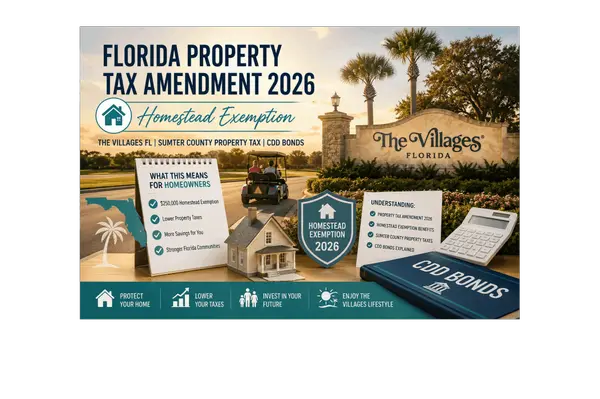
- The non-school homestead exemption jumps to $150,000 on January 1, 2027
- It rises again to $250,000 on January 1, 2028
- Starting 2029, it's indexed to inflation — so it keeps up over time
For a home assessed at $400,000 in Sumter County, that could mean a dramatically lower annual tax bill. Homes assessed at $250,000 or less could effectively owe zero non-school property taxes by 2028.
The current annual property tax bill in The Villages runs roughly $3,300–$3,800 for an average-priced home, with an effective rate of about 0.89% in Sumter County. This amendment targets the non-school portion of that bill — which is typically the larger share.
The December 31 Deadline Nobody's Talking About
Here's the piece that should be on every prospective buyer's radar.
To qualify for the full expanded exemption when it takes effect, you must be a Florida permanent resident — meaning you've established Florida as your primary residence and filed for homestead — by December 31, 2026.
If you move to Florida and establish residency on or before that date, you're in. When January 1, 2027 arrives, you get the full exemption.
If you move after December 31, 2026? You enter a five-year transitional period. During those five years, you receive only a $50,000 exemption on your homestead — the same as today — until you've been a Florida resident for five full years. Only then do you step up to the full benefit.
I've been walking clients through this calculation all week. For a buyer considering a $500,000 home in Eastport or Middleton, the difference between moving before and after December 31 could easily be $1,500–$2,000 per year in property taxes over those five transitional years — real money that adds up.
What "Establishing Residency" Actually Means
This isn't just about buying before the end of the year. To qualify, you need to make Florida your legal primary residence — which means:
- Closing on or occupying your home in Florida
- Filing a homestead exemption application with the county property appraiser (typically filed by March 1 of the following tax year)
- Updating your driver's license, voter registration, and other official records to reflect your Florida address
The property appraiser determines eligibility — not the deed date alone. Talk to a local title company or attorney if your situation is complex (selling a home in another state, maintaining a part-time residence elsewhere, etc.).
What This Doesn't Cover
Before you start recalculating your retirement budget, a few important clarifications.
School district taxes are not affected. The expanded exemption applies only to the non-school portion of your property taxes. Your school millage still applies.
CDD bonds are entirely separate. This is one of the most common misconceptions I hear. The Villages' CDD bonds — which finance the infrastructure for each neighborhood — appear on your annual property tax bill, but they are not ad valorem taxes. They're a fixed bond payment. This amendment does not reduce, modify, or eliminate your CDD bond balance or your monthly CDD maintenance fee (currently around $204/month). Those are separate obligations that stay the same.
The amendment still needs voter approval. Florida voters will decide in November 2026, and the amendment needs 60% support to pass. That's not a certainty. Strong political support has it polling well, but nothing is final until the votes are counted.
What Smart Buyers Are Doing Right Now
I want to be honest with you: I don't think anyone should make a $400,000 or $600,000 real estate decision purely because of a tax amendment that hasn't passed yet. That's not smart planning — that's chasing a deadline.
What I do think is worth doing:
- Run the numbers on your specific situation. How much would the exemption save you, given the assessed value range of the homes you're looking at? What's the five-year cost of the transitional period if you wait? This is a concrete calculation, not a guess.
- If you were already planning to move in the next 12–18 months, understand what December 31 means for you. The math might make accelerating your timeline worthwhile. Or it might not — it depends on your price range, your county, and your personal situation.
- Get pre-approved now, even if you're not ready to commit. Pre-approval is free, it takes a few days, and it means you're positioned to move quickly if you decide the deadline matters.
- Talk to a tax professional, not just your real estate agent. I can walk you through the real estate side of this. A CPA or tax attorney who knows Florida law should help you understand the full personal finance picture.
The Villages market in the first half of 2026 has been running at a balanced pace — homes are sitting 47–55 days on average, prices have moderated from the peak. You're not in a frenzied multiple-offer market. There's time to be thoughtful here.
What This Means If You're Selling in The Villages
If you're a current Villages homeowner with a homestead exemption, you're already positioned to benefit from the expanded exemption — no December 31 action required on your part. If the amendment passes, your 2027 tax bill goes down automatically.
On the selling side, this amendment is likely to drive increased interest in The Villages from out-of-state buyers in the second half of 2026 — particularly retirees from high-tax states who see a genuine financial incentive to establish Florida residency before year-end. If you're considering listing, that's a meaningful tailwind for demand in the months ahead.
This is exactly the kind of question I walk every buyer and seller through before we talk about homes — because your financial picture shapes the whole strategy. If you're planning a move to The Villages and want to map out what this amendment means for your specific timeline and budget, I offer a complimentary retirement relocation consultation. We'll go through the numbers together, no pressure. Schedule a conversation here.
Frequently Asked Questions
Does Florida's 2026 property tax amendment affect CDD bonds in The Villages?
No. CDD bond payments are separate from ad valorem property taxes and are not affected by the proposed homestead exemption expansion. If the amendment passes, your annual property tax bill decreases, but your CDD bond balance and monthly CDD maintenance fee remain unchanged.
When is the deadline to qualify for the full Florida homestead exemption under the new amendment?
Buyers must establish Florida permanent residency by December 31, 2026 to qualify for the full expanded homestead exemption immediately when it takes effect on January 1, 2027. Buyers who move to Florida after that date enter a five-year transitional period with a smaller initial exemption — just $50,000 — until they've been Florida residents for five years.
How much could I save on property taxes in The Villages if this amendment passes?
Savings depend on your home's assessed value and which county your home is in (The Villages spans Sumter, Lake, and Marion counties, each with different millage rates). On a $450,000 home in Sumter County, eliminating the non-school portion of taxes on the first $250,000 of assessed value starting in 2028 could reduce your annual tax bill by roughly $1,200–$1,800. Your exact number depends on your assessed value and applicable millage rates — I'm happy to run a personalized estimate.
Is the Florida property tax amendment guaranteed to pass?
No. The amendment is on the November 2026 ballot and requires at least 60% voter approval to take effect. While it has strong legislative and gubernatorial backing, nothing is final until voters decide. Smart buyers are planning for both outcomes rather than timing their move entirely around the vote.
Does the Florida property tax amendment affect sellers in The Villages?
Current Florida homestead holders benefit automatically — if the amendment passes, your 2027 tax bill drops without any action on your part. For sellers, the amendment may attract more out-of-state buyers eager to establish Florida residency before December 31, which could support demand and pricing in The Villages through the end of 2026.
This post is for informational purposes only and does not constitute legal, tax, or financial advice. The Florida property tax amendment has not yet been approved by voters. Consult a licensed CPA or attorney for guidance specific to your situation.
Categories
- All Blogs (6)
- Buyer & Seller Process / Local Market & Legislative Update (1)
- Buyer Resources, The Villages FL Property Taxes & Costs, Retirement Relocation (2)
- Florida Real Estate News Buyer Resources The Villages Market Update Tax & Financial Planning (2)
- Florida Real Estate News Buyer Resources The Villages, FL Property Taxes & Costs Retirement Relocation (1)
- health & lifestyle amenities (1)
- the villages market update (1)
Recent Posts




GET MORE INFORMATION

Real Estate Agent License ID: SL3528876
+1(352) 913-1085 | gina@battagliahomegroup.com